Programs
Bachelor of Science in Engineering (BSE) in Electrical Engineering
Be recognized for having two top degrees in electrical engineering.
In Saudi. By employers. Across the world.

Program Name Electrical Engineering
Qualification Bachelor of Science in Engineering (BSE)
Duration 4 years + Foundation Year
Fees Degree: 100K SAR per year Foundation: 80K SAR
Start date September 2026

Why study electrical engineering?
Saudi Arabia is investing more in its national grid, power generation, and energy infrastructure than at any point in its history. Vision 2030’s giga-projects are advancing fast. This is fueling sustained demand for skilled electrical engineers in the Kingdom, with electrical engineering salaries in Saudi Arabia now averaging around SAR 233,000 per year.
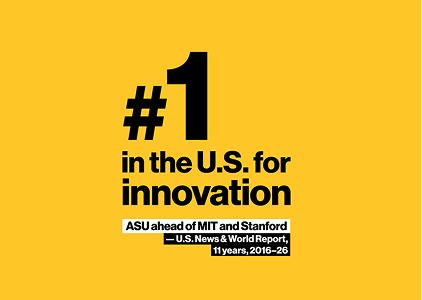
Upon graduation you will receive a Bachelor of Science in Engineering (BSE) in Electrical Engineering from Kingdom University and one from Arizona State University (ASU), ranked #1 in the U.S. for innovation for 11 consecutive years (U.S. News & World Report, 2016–2026). With a local degree and an international degree you can double your career opportunities, both locally and globally.

Summary
Program Summary
Kingdom University’s Bachelor of Science in Engineering in Electrical Engineering offers curriculum inspired by Ira A. Fulton Schools of Engineering at Arizona State University. The schools offer the largest and most comprehensive engineering programs in the United States. This engineering degree from Kingdom University also offers a pathway to a second degree from Arizona State university.
The program blends circuit design, electromagnetics, signal processing, and power electronics, preparing you to design the systems behind today’s most complex technologies.
The curriculum is built around learning by doing. In every semester, you will complete real projects that emphasize communication, teamwork, and professionalism, the same qualities demanded by Saudi Arabia’s most ambitious employers.
The program is accredited by the Engineering Accreditation Commission of ABET (abet.org) under the Electrical and Electronics Engineering Program Criteria, the global gold standard for engineering program quality.
Why Kingdom University for Electrical Engineering?
Two degrees, double the opportunity
Graduate with both a highly ranked U.S. degree from ASU and an accredited degree from Kingdom University, without leaving home. Or you have the option to complete your final year at ASU’s campus in Arizona.
World-recognized and ABET-accredited
The ASU program is accredited by ABET, the Engineering Accreditation Commission, and designed by the Ira A. Fulton Schools of Engineering at ASU, the largest engineering schools in the U.S.
Exceptional career prospects
Electrical engineers are in high demand across Saudi Arabia’s power, energy, and giga-project sectors. In Saudi Arabia, electrical engineers earn an average of SAR 233,000 per year, with senior-level engineers earning upwards of SAR 270,000.
A university that blends Saudi ambition with international excellence
Powered by ASU, Kingdom University offers world-class academic standards, with project-based learning and the latest curriculum for today’s modern world, giving ambitious students a globally respected degree, ranked amongst the world’s best. Graduates will join a network of over one million ASU alumni.
Program
What you will study each year
Term 1
- Intensive English I
- Foundation Mathematics I
- Academic Skills I
- Personal Finance
- Introduction to Engineering and Technology
Term 2
- Intensive English II
- Foundation Mathematics II
- Applied Digital Intelligence
- Emotional Intelligence and Resilience
- Project Management Fundamentals
- English for Undergraduate Admission and Achievement
Semester 1
- First-Year Composition I
- Introduction to Engineering
- Calculus for Engineers I
- General Chemistry for Engineers
- Innovation in Society
Semester 2
- First-Year Composition II
- Principles of Programming with C++
- Calculus for Engineers II
- University Physics I: Mechanics
- University Physics Laboratory I
- Digital Design Fundamentals
Semester 3
- Circuits I
- Calculus for Engineers III
- Modern Differential Equations
- University Physics II: Electricity and Magnetism
- University Physics Laboratory II
Semester 4
- Signals and Systems I
- Fundamentals of Electromagnetics
- Linear Algebra
- University Physics III
- Introduction to Philosophy
Semester 5
- Circuits II
- Random Signal Analysis
- Signals and Systems III
- Public Speaking and Presentations
Semester 6
- Hardware Design Languages and Programmable Logic
- Microeconomic Principles
- Technology, Social, and Sustainable Systems
- Communication Across Cultures and Global Engagement
- Properties of Electronic Materials
Semesters 7 and 8 provide students with the option to complete at ASU’s campus in Arizona or via online studies.
Semester 7
- Senior Design Laboratory I
- Digital Signal Processing
- Upper Division Technical Elective (any qualifying ASU course)
- Upper Division Technical Elective (any qualifying ASU course)
- United States to 1865
Semester 8
- Elective (any qualifying course)
- Senior Design Laboratory II
- Energy Systems and Power Electronics
- Upper Division Technical Elective (any qualifying ASU course)
- Upper Division Technical Elective (any qualifying ASU course)
For more information about the Bachelor of Science in Engineering (BSE) in Electrical Engineering program,
contact us. Please note that these courses are scheduled but can change at any time. Request the current
schedule via the plan of study when you apply.
Careers
Careers and opportunities
Electrical engineers solve a broad set of transdisciplinary problems and apply new technologies to improve quality of life.
Globally, electrical and electronics engineering roles are projected to grow by 7% between 2024 and 2034 (U.S. Bureau of Labor Statistics). In Saudi Arabia, Vision 2030 is creating unprecedented demand for electrical engineers across the national grid, renewable energy, and giga-project sectors.
With this degree you can work in:
- Power systems and electrical grid engineering
- Renewable energy engineering (solar and wind)
- Energy and power electronics engineering
- Electronics and semiconductor engineering
- Signal processing and telecommunications engineering
- Robotics and automation engineering
- Aerospace and avionics electrical systems
- Computer hardware engineering
- Nuclear and energy engineering
- Giga-projects and Vision 2030 energy roles
ASU, recognized globally as a leading knowledge enterprise
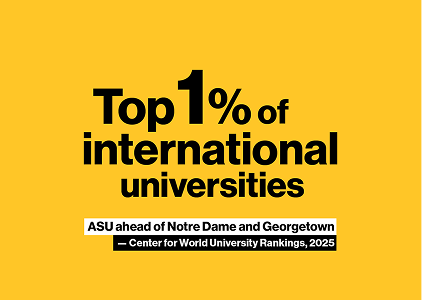
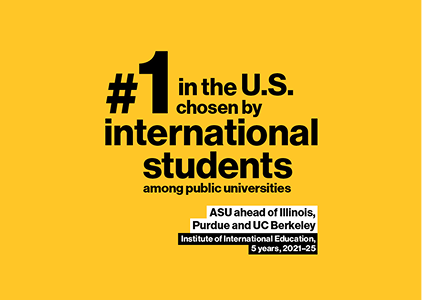
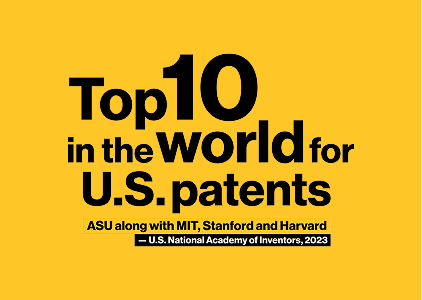
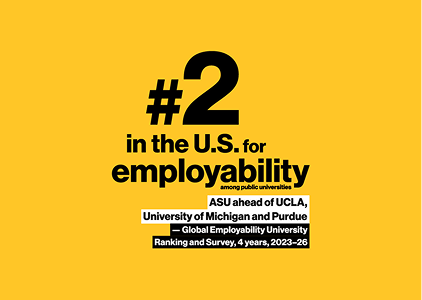
To get a career advantage, you need a university degree recognized by employers throughout the world. The Ira A. Fulton Schools of Engineering at Arizona State University is one of the largest and most highly regarded engineering schools in the United States. Just a few of ASU's many accolades include:

More awards and rankings here at asu.edu/about/rankings.